Case Study
Building a Hosted Fortnox MCP and Finance Operations Platform
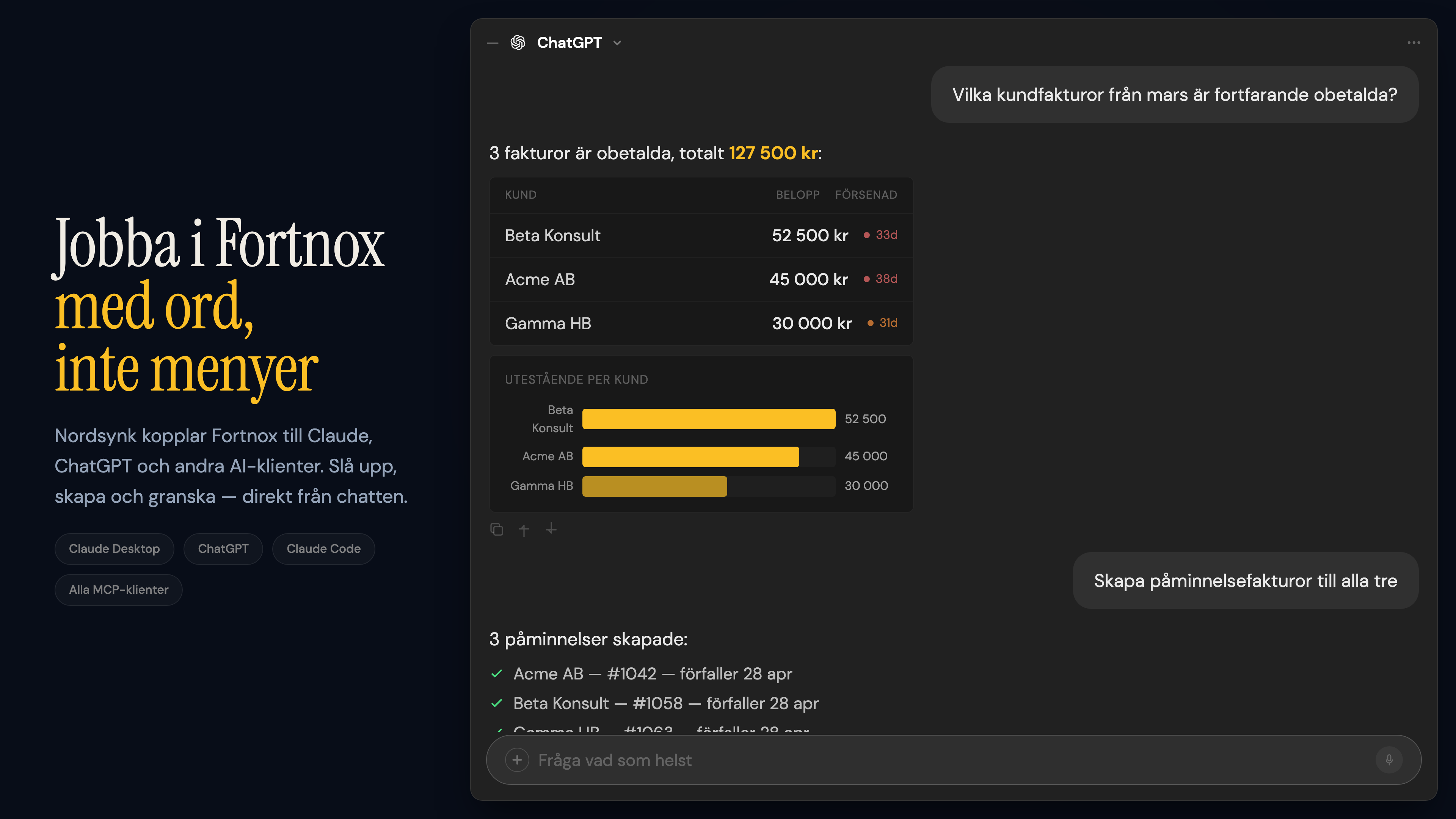
Nordsynk connects Fortnox to Claude, ChatGPT, Cursor, and other MCP clients through a secure hosted gateway. We built the product around a clear promise: work faster with live finance data, keep humans in control, and show the evidence behind every recommendation.
Overview
Nordsynk started from a precise product question: what would it take to let Swedish finance teams work with live Fortnox data from the AI tools they already use, without asking them to self-host infrastructure, manage API credentials, or trust an unrestricted agent with accounting writes?
The answer became a hosted MCP platform for Fortnox. The public surface is intentionally compact: connect your company, ask for the finance work you need, review the evidence, and approve sensitive changes before anything is written. Behind that simple experience is a product system for consent, access control, usage visibility, onboarding, support, and bureau-specific multi-company workflows.
The Challenge
Fortnox is not a toy integration. Customers expect access to invoices, customers, suppliers, vouchers, orders, payments, and workflow state. Accounting bureaus need to move across many connected client companies, and finance teams need confidence that an AI assistant understands the context before it suggests action. On top of that, any write must be treated as a real accounting operation, not just another API mutation.
The product also needed to work across modern MCP clients. Claude, ChatGPT, Cursor, and desktop clients all have slightly different UX constraints around authentication, tool discovery, and interactive approval. Nordsynk had to make the core Fortnox experience consistent across those clients while staying strict about tenant boundaries and write intent.
What we built
The platform runs as a hosted remote MCP service, so customers do not need to self-host a server or manage Fortnox credentials. OAuth consent anchors the connection, and every action is evaluated against the company, user, and workflow context before the assistant gets access to the relevant finance surface.
We designed the assistant interface to feel broad without feeling chaotic. It can handle common Fortnox workflows, answer finance questions with source context, and prepare next actions, while the product keeps sensitive operations behind explicit review.
Safety model
The key design decision was to separate discovery, read operations, suggested actions, and writes. Reads can happen through the authenticated Fortnox runtime. Suggested actions can be presented by the assistant. But mutating Fortnox requests must carry explicit write intent and pass through an approval flow that is locked to the exact request being executed.
The approval experience is designed for non-technical users: explain the accounting change, show enough context to verify it, and only proceed when the human confirms the exact action. This gives the product its edge without turning every session into a risk negotiation.
Product layers
The customer-facing web app handles setup, Fortnox consent, activation, support, and dashboard surfaces. The operational side gives the team the visibility needed to support a finance product in production without exposing customers to internal complexity.
For accounting bureaus, we built a dedicated Byra edition. A bureau can connect many client companies, invite consultants, grant client access, track connection health, and manage the operational reality of serving multiple Fortnox customers from one workspace.
Finance Control Preview
Nordsynk also includes a read-only finance-control preview. The daily playbook checks payment changes, overdue invoice reminders, delivery readiness, cost movement anomalies, and open accounting questions. It never writes to Fortnox; it turns review work into a structured queue of findings, decisions, and feedback.
Each finding carries evidence pointers back to the Fortnox or Nordsynk object that supports it. This matters for trust: the AI layer is not asking finance teams to accept unsupported summaries. It shows which source record or remembered decision explains the recommendation.
Nordsynk was designed around a simple trust boundary: read approved records, show the evidence, remember human decisions, and require an explicit approval before changing Fortnox.
Engineering outcomes
The result is a production-grade AI finance platform rather than a thin API demo. Nordsynk pairs broad Fortnox coverage with a trust model that finance teams can understand: connect securely, inspect the evidence, approve writes intentionally, and give bureaus a practical way to manage many client companies from one place.
'%3e%3cpath%20d='M13.0928245,196.870783%20L0.260265668,236.513104%20C-0.580418421,240.600573%200.753678147,244.832026%203.78671025,247.698189%20C6.81974236,250.564352%2011.1198467,251.657122%2015.1532636,250.58673%20L56.2776986,238.561491%20C60.7084357,237.682641%2065.296983,238.066759%2069.5199354,239.67003%20C122.639608,264.476776%20185.904536,247.450272%20219.398181,199.333267%20C252.891825,151.216261%20246.892054,85.9755766%20205.18438,44.7743424%20C163.476705,3.57310822%2098.1675272,-1.62927916%2050.4631899,32.4495883%20C2.75885255,66.5284557%20-13.493605,129.996576%2011.9601855,182.809206%20C13.731912,187.278485%2014.1263628,192.175544%2013.0928245,196.870783%20Z'%20id='Path'%20fill='%23000000'%3e%3c/path%3e%3cpath%20d='M82,88.2250395%20C81.9987004,83.8480019%2084.3435642,79.8044683%2088.1475005,77.6241587%20C91.9514367,75.4438491%2096.6335652,75.4597077%20100.422577,77.6657349%20L173.898527,120.428474%20C177.672117,122.613173%20179.99621,126.635606%20180,130.988616%20C180.00378,135.341626%20177.686686,139.368077%20173.9169,141.559305%20L100.422577,184.334265%20C96.6335652,186.540292%2091.9514367,186.556151%2088.1475005,184.375841%20C84.3435642,182.195532%2081.9987004,178.151998%2082,173.774961%20L82,88.2250395%20Z'%20id='Path'%20fill='%23FFFFFF'%3e%3c/path%3e%3cpath%20d='M184.1697,-6%20C185.645539,-6%20187.057214,-5.58339432%20188.263785,-4.8391499%20C189.478661,-4.08978292%20190.485511,-3.00862949%20191.14721,-1.68037064%20L198.948213,14.0190082%20C199.118536,14.3614755%20199.451166,14.5911825%20199.82632,14.6458937%20L217.265912,17.1815808%20C218.730237,17.3923739%20220.070202,18.0081525%20221.158935,18.9194987%20C222.255934,19.8377635%20223.097995,21.0558029%20223.558913,22.4639109%20C224.02193,23.8784292%20224.060556,25.3621939%20223.715581,26.7519132%20C223.371843,28.1366494%20222.646965,29.428544%20221.575954,30.4660641%20L208.959345,42.6725135%20C208.698361,42.9252019%20208.573668,43.2884343%20208.6346,43.6427731%20L211.611902,60.8816215%20C211.868474,62.346585%20211.695691,63.8205133%20211.156212,65.1474099%20C210.617247,66.4730438%20209.711895,67.6522916%20208.50135,68.5258772%20C207.299632,69.3930926%20205.901882,69.882866%20204.47634,69.9814171%20C203.059013,70.0794002%20201.614844,69.7905711%20200.309993,69.1047834%20L184.724661,60.9633335%20C184.376125,60.7815029%20183.959899,60.7815029%20183.614682,60.9616002%20L168.025656,69.106743%20C166.719057,69.7916335%20165.273442,70.078794%20163.85529,69.9786485%20C162.432052,69.8781439%20161.037106,69.3876391%20159.837887,68.5211028%20C158.629867,67.6482072%20157.72614,66.4707573%20157.187657,65.1472699%20C156.648191,63.821368%20156.474913,62.3485311%20156.730392,60.8844212%20L159.70474,43.6464811%20C159.766524,43.2886192%20159.642095,42.9260489%20159.38226,42.674646%20L146.769585,30.4753571%20C145.69862,29.4434413%20144.970302,28.1535327%20144.622837,26.7697804%20C144.27286,25.3760199%20144.308971,23.8865122%20144.772845,22.4662392%20C145.234615,21.0524105%20146.080474,19.8301137%20147.182677,18.9100866%20C148.271933,18.0008665%20149.611665,17.3871538%20151.075065,17.1779913%20L168.514678,14.6451724%20C168.891907,14.5906468%20169.224285,14.3614597%20169.393157,14.0218411%20L177.19492,-1.68585527%20C177.85389,-3.00862949%20178.86074,-4.08978292%20180.075616,-4.8391499%20C181.282187,-5.58339432%20182.693862,-6%20184.1697,-6%20Z'%20id='Path'%20stroke='%23FFFFFF'%20stroke-width='12'%20fill='%23000000'%20stroke-linecap='round'%20stroke-linejoin='round'%3e%3c/path%3e%3c/g%3e%3c/g%3e%3c/svg%3e)
